Classic Military Vehicle On Jeep
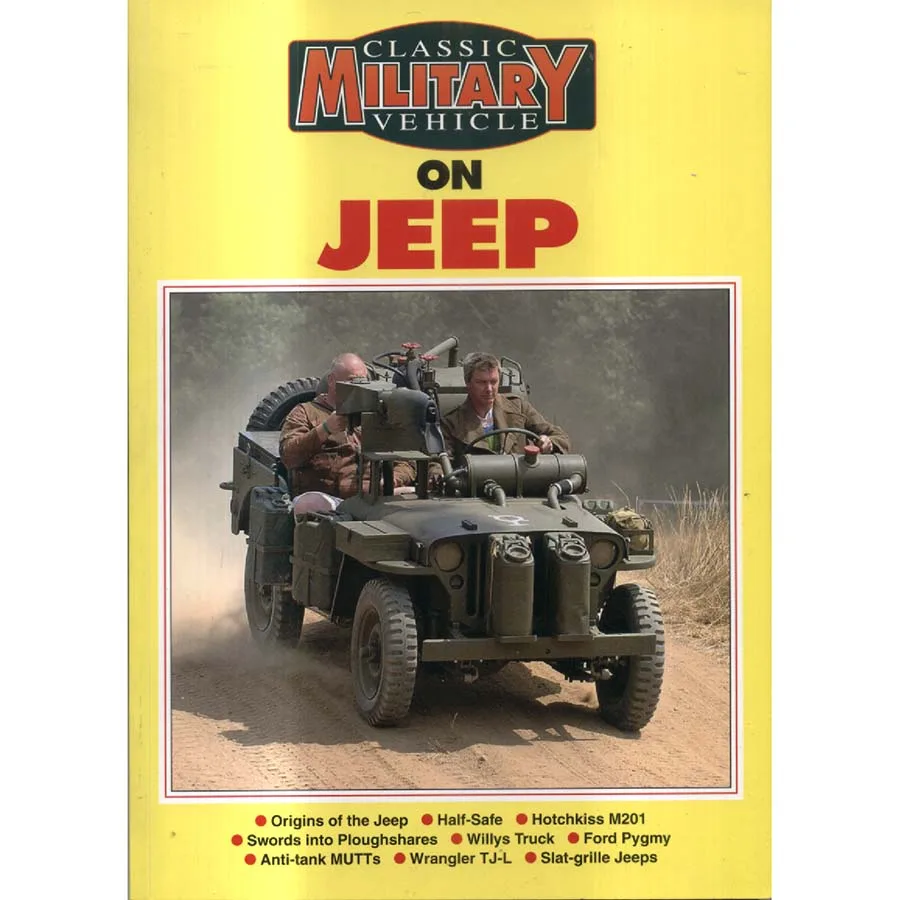
Publisher: Kelsey Publishing
Format: Paperback
ISBN: 9780187309875
There are military vehicles designed to carry enormous guns, vehicles built to withstand artillery fire, and vehicles requiring a small army of mechanics simply to persuade them to start. Then there is the Jeep, a wonderfully basic little machine that helped the Allies win the Second World War while offering approximately the same level of passenger comfort as a garden wheelbarrow. It was rugged, versatile, remarkably capable and possessed almost nothing that could reasonably be described as a luxury, which naturally made it one of the greatest military vehicles ever invented.
In Classic Military Vehicle on Jeep (2006), respected military vehicle historian Pat Ware explores the remarkable story of the legendary Jeep, the compact American four-wheel-drive machine that became an enduring symbol of Allied mobility and mechanical ingenuity. Published by Kelsey Publishing, this illustrated volume celebrates the engineering, historical significance and extraordinary versatility of a vehicle whose influence extended far beyond the battlefields of the 1940s.
The Jeep’s origins lay in the urgent military requirements of 1940, when the United States Army needed a lightweight reconnaissance vehicle capable of transporting personnel and equipment across difficult terrain. American Bantam pioneered an early design, while Willys-Overland and Ford became central to the mass production of the machines that would accompany Allied forces around the world.
The resulting Willys MB and Ford GPW were masterpieces of practical simplicity. Their modest dimensions, four-wheel-drive capability and robust construction allowed them to negotiate conditions that would reduce an ordinary civilian saloon to a collection of stranded mechanical components. They could carry soldiers, tow equipment, transport casualties and undertake countless other duties, often while being driven by men who had received considerably more instruction in military discipline than preventative vehicle maintenance.
Ware’s exploration of the Jeep recalls its extraordinary wartime service and the technical details that continue to fascinate collectors and restorers. To the uninitiated, most wartime Jeeps look reassuringly similar. To the dedicated enthusiast, however, the position of a bracket, the shape of a component or the precise arrangement of a dashboard fitting can provide sufficient material for an entire afternoon’s argument.
Following the war, the Jeep’s reputation ensured its continued popularity among military organisations, farmers and adventurous civilians. Its fundamental design inspired generations of four-wheel-drive vehicles, proving that a machine originally intended for military reconnaissance could become the ancestor of countless recreational vehicles purchased by people whose most demanding expedition involves a muddy supermarket car park.
Naturally, the Jeep remains a favourite among historic military vehicle enthusiasts, who lovingly restore surviving examples with extraordinary dedication, occasionally spending considerably more money than the original American government ever intended.
Condition: As New. This copy is in exceptional condition, presenting as new despite its 2006 publication date. Unlike a genuine wartime Jeep, it requires no replacement canvas hood, extensive welding or painstaking reconstruction of seventy-year-old electrical wiring.
Published by Kelsey Publishing in 2006. ISBN: 9780187309875.
Offered by Crappy Old Books, where we appreciate magnificent military machinery, particularly when owning a piece of its history does not require a garage, a restoration budget or permission to park an olive-drab vehicle on the lawn.
An excellent addition to any collection of military vehicle literature, Second World War history or classic Jeep memorabilia. Particularly recommended for enthusiasts who admire a vehicle that conquered some of the world’s most difficult terrain while possessing little more than four wheels, a modest engine and a magnificent determination to keep going.
Keep browsing: See more Transport books Other books by Pat Ware